Exporting buses, heavy trucks, excavators and power generation equipment from China — choosing the correct ocean freight mode directly determines cargo safety, transit time and overall logistics cost. There is no absolutely “best” solution: mode selection depends on whether the equipment is self-propelled, its external dimensions and weight, the terminal conditions at the port of discharge, the project schedule and the budget.
Bloom Supply Chain handles a large volume of vehicle and construction machinery exports every year. This article breaks down four options — Ro-Ro, break-bulk heavy-lift vessel, flat rack and standard 40HQ high cube — to help customers complete their logistics decision before requesting a quotation.
1. A Detailed Look at the 4 Core Ocean Freight Modes for Heavy Equipment Exports
1.1 Ro-Ro (Roll-on / Roll-off)
Ro-Ro vessels work with heavy-duty ramps. Self-propelled cargo is driven directly on board, while tracked equipment has to be carried on MAFI trailers. No crane lifting is required at any stage. Multiple enclosed decks provide protection for rolling cargo.
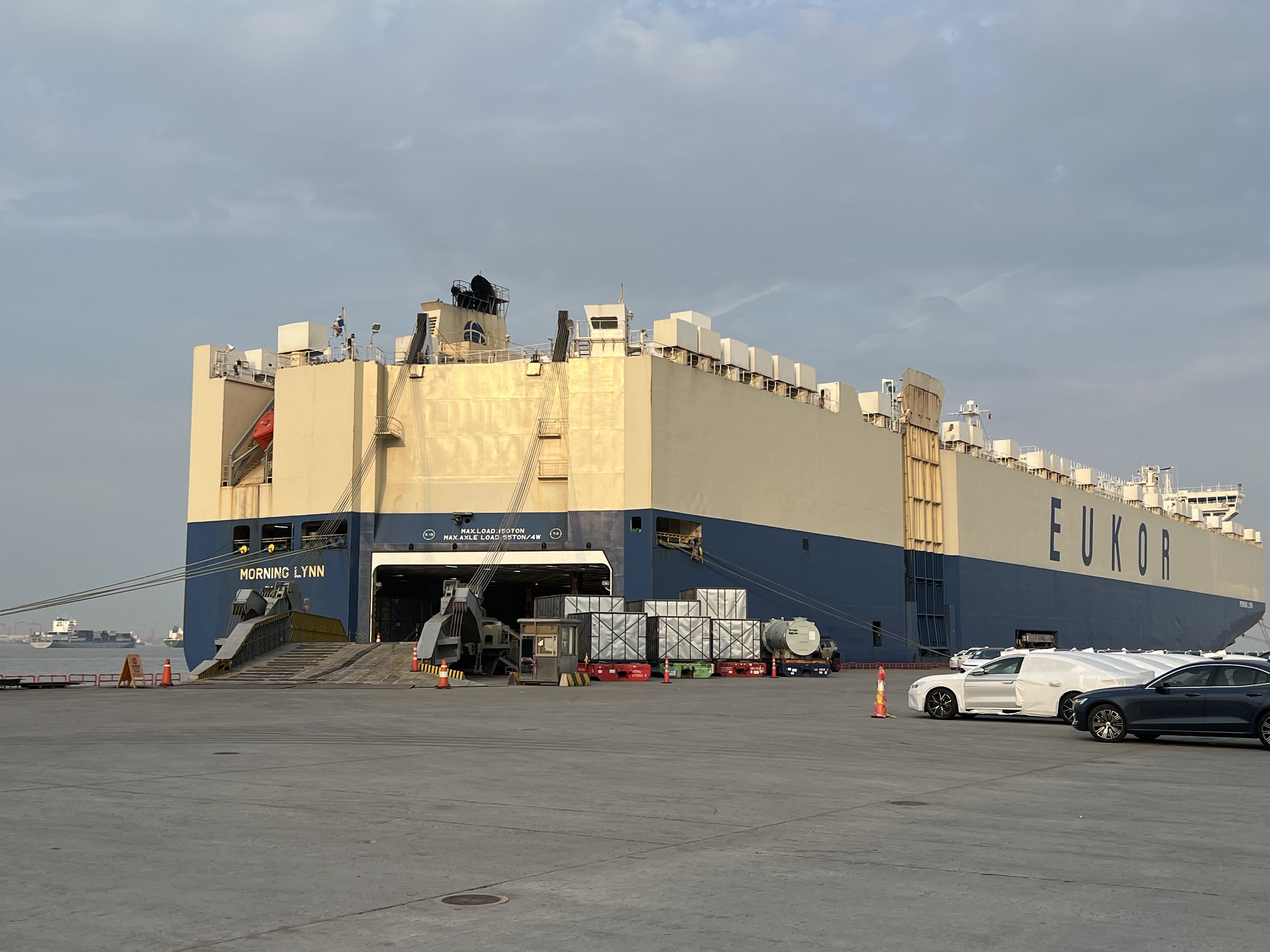
Self-propelled wheeled vehicles and construction machinery.
Avoids structural cargo damage caused by crane lifting; high terminal loading and unloading efficiency; a per-unit cost advantage on large-volume shipments.
Both the port of loading and the port of discharge must have Ro-Ro ramp terminals; purely static equipment with no self-propulsion cannot use standard Ro-Ro; new energy vehicles require prior approval from the carrier; spare parts, tools and sundries must not be left inside the vehicle cabin.
1.2 Break-bulk / Multi-purpose Heavy-Lift Vessel
The vessel carries its own large deck cranes, and cargo is lifted on and lifted off (Lo-Lo). There is virtually no hard upper limit on cargo weight or external dimensions.
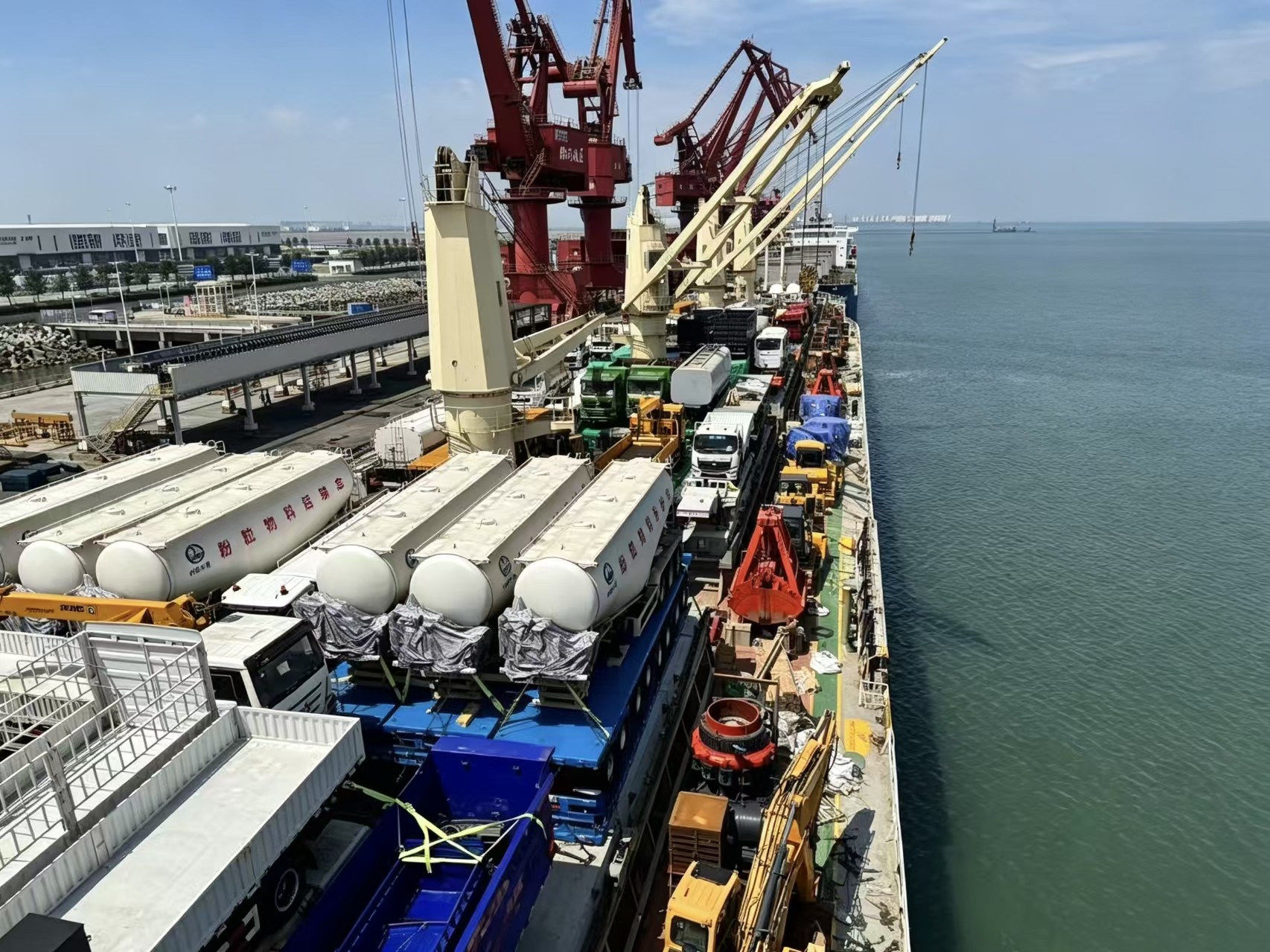
Overweight, over-dimensional, non-self-propelled project cargo: tracked excavators, large generator sets, transformers, steel structures.
Suitable for oversized and overweight pieces; can operate at ports that are equipped with heavy-lift handling facilities.
Repeated lifting carries a risk of impact damage; sailing schedules are irregular because the vessel waits to accumulate cargo, so the waiting period is uncertain; deck-loaded cargo is exposed to salt spray and rain; an incorrect declaration of dimensions or weight results in substantial dead-freight charges.
1.3 Standard 40HQ
A closed standard container with internal dimensions of 12.03 m (L) × 2.35 m (W) × 2.69 m (H). Most construction machinery requires the removal of protruding parts such as mirrors and bumpers.
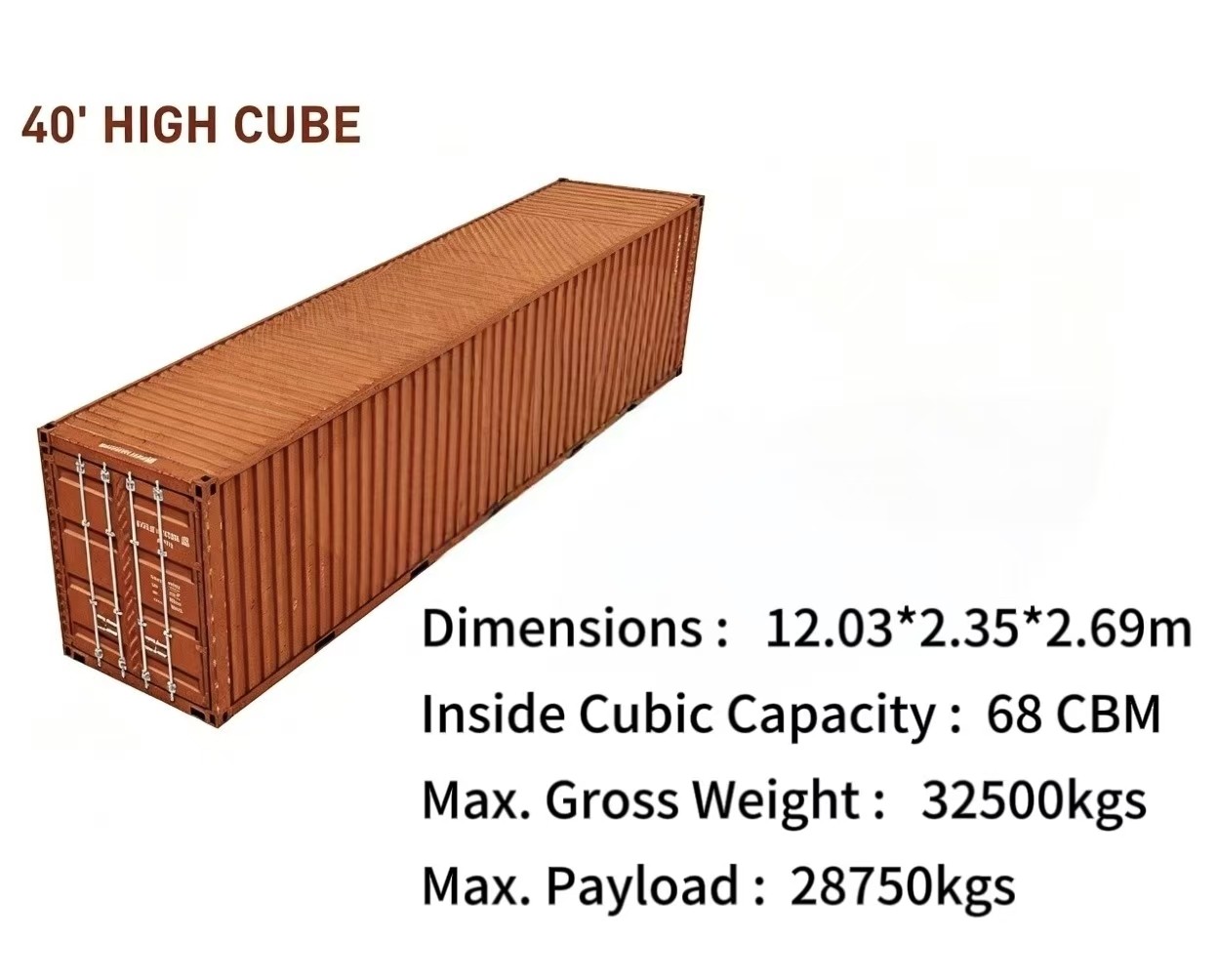
Compact small equipment and small vehicles; spare parts can be consolidated into the same container.
The closed container body protects against rain and theft; frequent liner sailings and extensive global terminal coverage.
Strict limits on length, width, height and weight; dismantling and reassembly bring labour costs and damage risk; lithium-battery equipment must complete the full IMDG dangerous goods declaration.
1.4 Flat Rack (OOG Over-Dimensional Container)
A flat rack is a reinforced frame container with no side walls and no roof, carried on ordinary container liner services. Over-dimensional equipment is secured with chains, and the cargo extends beyond the length, width or height of the container, which makes it Out-of-Gauge (OOG) cargo.
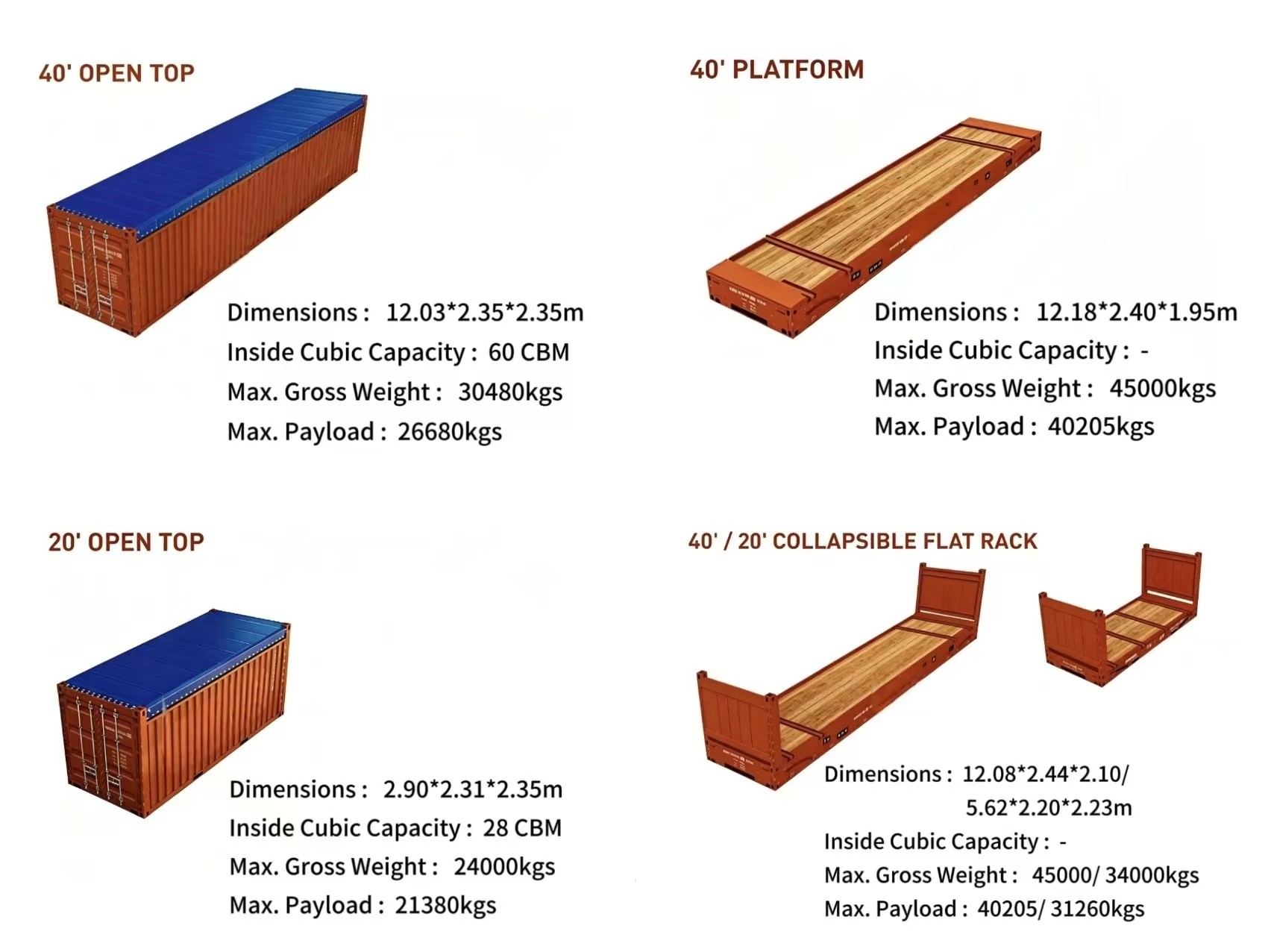
Slightly over-dimensional, non-self-propelled equipment — cases that are not large enough to justify a break-bulk vessel.
Leverages the stable and frequent schedules of container liner services; the vast majority of container terminals can handle this option.
The cargo is fully exposed to the open air and must be completely wrapped for rust and rain protection; OOG surcharges are incurred at both the port of loading and the port of discharge; failed lashing carries a risk of cargo shifting.
2. Comprehensive Comparison of the Four Options
Use the table below to screen all four modes against the same criteria before requesting rates.
| Comparison item | Ro-Ro | Break-bulk heavy-lift vessel | Flat rack | Standard 40HQ |
|---|---|---|---|---|
| Suitable cargo | Self-propelled buses, trucks and wheeled construction machinery; tracked equipment must be carried on MAFI trailers. | Overweight and over-dimensional static equipment: tracked excavators, generator sets, transformers. | Slightly over-dimensional non-self-propelled equipment, with a maximum payload of approximately 45 tonnes. | Compact equipment and small vehicles (usually requiring partial dismantling); spare parts can be consolidated. |
| Cost structure | Charged per unit / per revenue tonne; Ro-Ro terminal handling charges; no lifting or container stuffing cost; peak-season space premiums may apply. | Charged on the greater of volume or weight; heavy-lift lifting charges, lashing and securing charges, terminal miscellaneous charges; a misdeclared size carries a dead-freight risk. | Container rental + ocean freight + OOG surcharge; lifting and rust-protection wrapping costs. | Ocean freight + container rental; stuffing and de-stuffing labour, internal lashing, THC terminal handling charges. |
| Transit time | Stable schedules on main trade lanes; China–Middle East 22–30 days, China–Africa 28–38 days; constrained by Ro-Ro terminal availability. | China–Middle East 25–33 days, China–Africa 32–45 days; irregular general cargo vessels that wait to accumulate cargo. | Stable container liner schedules; China–Middle East 22–28 days, China–Africa 30–45 days. | The most frequent sailings; China–Middle East 21–27 days, China–Africa 30–45 days. |
| Main risks | Low structural damage risk, although paint scuffing can occur; dependent on Ro-Ro terminals; new energy vehicles require carrier approval. | Impact damage from repeated lifting; salt spray corrosion of deck cargo; penalties for misdeclared dimensions or weight. | Corrosion from exposure to sea air and rain; shifting caused by lashing failure; over-dimensional surcharges at the port of discharge. | Damage risk from dismantling and reassembly; lithium-battery equipment must complete a compliant dangerous goods declaration. |
| Applicable scenarios | Large volumes of self-propelled vehicles and machinery; the port of discharge has a Ro-Ro ramp. | Overweight and severely over-dimensional project cargo; the port of discharge has heavy-lift handling facilities. | Small to medium volumes of over-dimensional equipment that need stable liner services where no Ro-Ro option exists. | Small-volume shipments and consolidated spare parts; the port of discharge only has ordinary container terminals. |
3. Hidden Critical Factors You Cannot Ignore Before Choosing a Mode
3.1 Physical characteristics of the cargo itself
- Whether the cargo can be driven on its own is the first criterion in Ro-Ro mode selection.
- A total weight above 45 tonnes immediately rules out the flat rack option.
- Protruding components on the equipment determine whether the container option requires dismantling.
- Whether the cargo is lithium-battery / new energy equipment determines the dangerous goods compliance workload, which differs completely from mode to mode.
3.2 Terminal hardware constraints at the port of loading and the port of discharge
Even if the cargo suits a particular transport mode, the option is simply not feasible if the port of discharge does not have the corresponding facilities.
- Some secondary ports in Africa and the Middle East have no Ro-Ro ramp, so cargo can only be transhipped or switched to another transport mode.
- Many regional ports have insufficient heavy-lift crane capacity and cannot discharge a break-bulk vessel.
- Some terminals levy extremely high surcharges on OOG flat racks.
3.3 Project schedule and risk buffer
- Break-bulk general cargo vessels cannot guarantee a fixed sailing date, so a longer buffer must be allowed.
- Ro-Ro main trade lanes are stable, but peak-season space is sold out 4–8 weeks in advance.
- Container options (flat rack / 40HQ) have fixed schedules, but dismantling and stuffing consume lead time.
Step-by-Step Mode Selection Workflow
Screen the right option with this workflow.
-
1
Collect basic cargo information
Length, width and height, gross weight, actual photographs, whether the cargo is self-propelled, whether it is lithium-battery equipment, and whether components can be dismantled.
-
2
Assess terminal handling capability at the port of loading and the port of discharge
Confirm whether the port of discharge has a Ro-Ro ramp; whether a break-bulk vessel has cranes of the required capacity; and whether OOG cargo attracts high surcharges.
-
3
First-round elimination
- 1) The equipment is self-propelled and the port of discharge has a Ro-Ro terminal → Ro-Ro vessel takes priority
- 2) Weight > 45 tonnes → rule out the flat rack and compare break-bulk vessels
- 3) The port of discharge has neither a Ro-Ro ramp nor heavy-lift cranes → rule out Ro-Ro and break-bulk, and select a flat rack or a standard container
- 4) The equipment fits into a 40HQ after dismantling → add the standard container to the shortlist
-
4
Compare the all-in cost, risk and lead time of the remaining shortlisted options
Do not compare ocean freight alone — calculate the total landed cost and risk.
-
5
Verify special cargo
For new energy vehicles and modified equipment, confirm the carrier’s acceptance conditions and the complete documentation set.
-
6
Confirm the mode and allow sufficient lead time to secure space
Fix the mode and book early enough to lock in vessel space.
Pre-Shipment Risk Checklist
Check each item before confirming the transport mode.
- Measured length, width, height and gross weight data — estimated values are not acceptable
- Terminal handling capability verified at the port of loading and the port of discharge for the selected transport mode
- An all-in quotation obtained, itemising ocean freight, surcharges and terminal charges
- Lithium battery / new energy vehicles: carrier pre-approval and dangerous goods documentation confirmed
- Ro-Ro: confirmed that there are no spare parts, tools or sundries inside the vehicle cabin
- Break-bulk / flat rack: centre of gravity (CoG) data provided for lashing design
- Project buffer time allowed in line with the characteristics of the transport mode
- A clear boundary of responsibility between buyer and seller for import certification
Frequently Asked Questions
Q1: For a quotation, what basic information do I need to prepare?
A: External dimensions of the equipment (L × W × H), gross weight, actual photographs of the equipment, HS code, port of loading, port of discharge, trade terms, required shipping date, and whether the equipment can be driven on its own.
Q2: My cargo can theoretically use two transport modes — how should I prioritise?
A: Compare three factors at the same time: the all-in landed cost, the expected risk of cargo damage, and schedule reliability. Do not look only at the freight price.
Q3: What can be done if the port of discharge does not have the corresponding terminal facilities?
Two mainstream solutions: ① tranship via a hub port that has the required hardware, then forward on a second leg; ② switch to another transport mode that matches the hardware available at the port of discharge. Transhipment adds extra cost and risk.
Q4: What happens if the declared dimensions or weight for a break-bulk shipment are wrong?
The shipping line will charge dead freight based on the actual measured data; in serious cases the cargo will be refused for loading. Break-bulk and flat rack shipments must always be supported by accurate measured data.
Q5: Which is cheaper in freight — a flat rack or a break-bulk heavy-lift vessel?
A: For weights within 45 tonnes and only slightly over-dimensional cargo, a flat rack is generally the more cost-effective choice; where the equipment is severely over-dimensional in weight or size, a break-bulk heavy-lift vessel should be prioritised.
Talk to a Project Cargo Specialist
Every heavy equipment export project is constrained by multiple factors — cargo parameters, terminal conditions, project schedule and compliance requirements. Bloom Supply Chain can recommend the optimal logistics solution based on your equipment parameters, terminal conditions and project schedule.
Bloom Supply Chain holds an NVOCC (Non-Vessel Operating Common Carrier) licence and specialises in project cargo logistics for vehicles, construction machinery and energy equipment. Our project team will combine your cargo parameters, terminal conditions, budget and schedule to give neutral, data-supported mode selection advice. We provide a complete service package covering pre-shipment assessment, loading supervision, customs declaration, ocean freight and destination coordination. Contact us for a free project assessment and a tailored quotation.
Neutral, data-supported mode selection advice from a licensed NVOCC project team.